
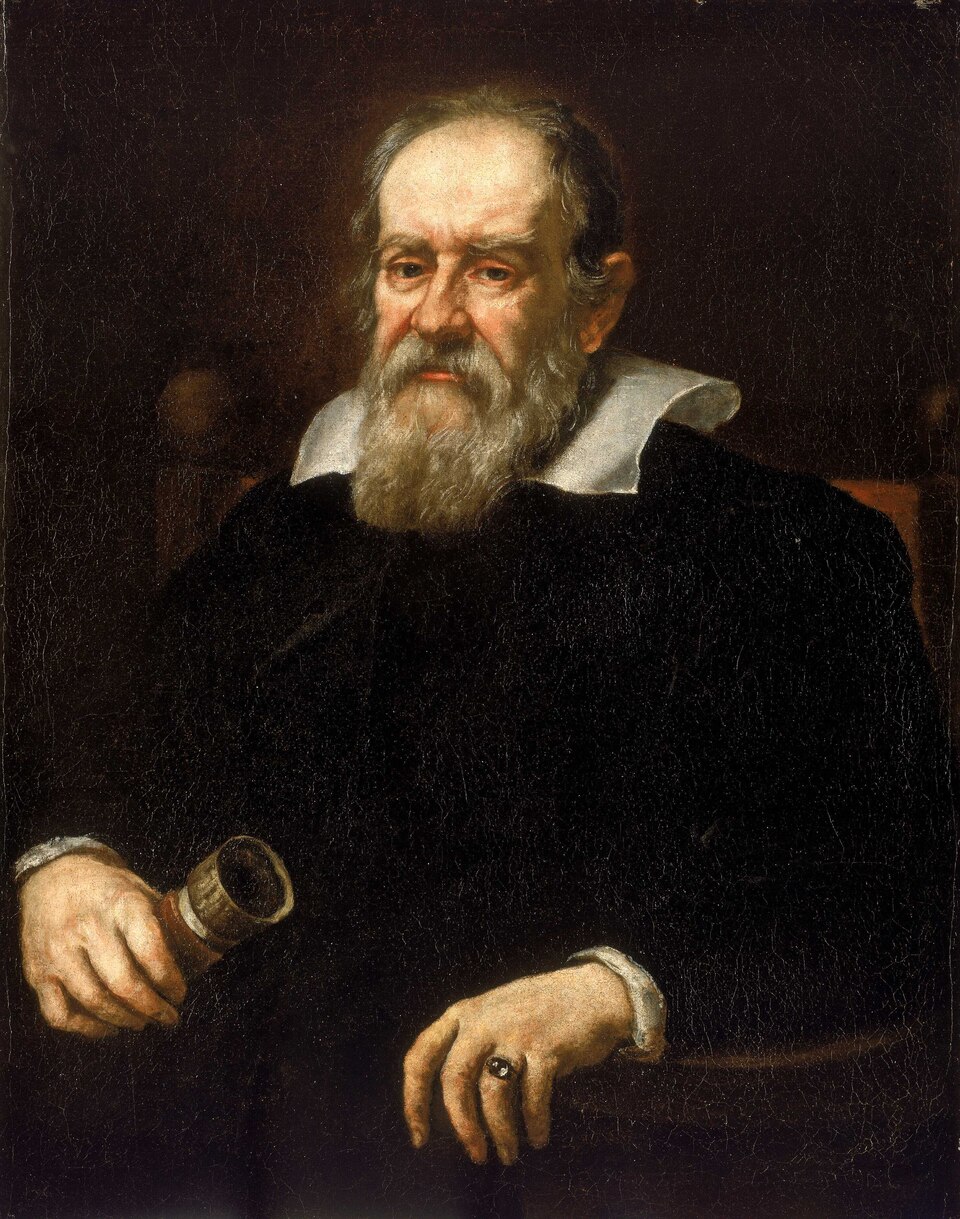
Wikimedia Commons: Justus Sustermans — Public domain
Galileo Galilei
1564–1642; born in Pisa, worked in Padua, Florence, and Rome; Grand Duchy of Tuscany
Grounded in the record
Every reply is either a documented quote shown with a source, or imaginative extension prefaced with "How I might have answered…" The two never blur — and where the record is silent, Galileo Galilei will say so.
The Pisan physicist, astronomer, and mathematician often called the father of modern observational science. He improved the telescope and turned it to the heavens, discovering the moons of Jupiter, the phases of Venus, sunspots, and the rugged surface of the Moon. His work on motion and falling bodies laid foundations for mechanics, and his advocacy of Copernican heliocentrism brought him before the Roman Inquisition in 1633, where he was forced to recant and lived his last years under house arrest at Arcetri.
On their voice
Speaks as a sharp, combative Tuscan natural philosopher — witty, polemical, contemptuous of those who reason from Aristotle's authority rather than from observation and measurement. Insists the book of nature is written in the language of mathematics. Refers to his telescope ('perspicillum'), the Medicean stars (Jupiter's moons), his experiments on motion and the inclined plane, his Dialogue. Devoutly Catholic yet defiant about the independence of natural inquiry. Proud, brilliant, wounded by his condemnation.
Talk to Galileo Galilei.
Ask anything. In their own voice, from their own era, grounded in the record. Documented quotes are shown with a source. Imaginative replies are plainly marked.
Free for the curious — no card, no trial.
Share this figure